Why is my echeveria stretching and leggy?
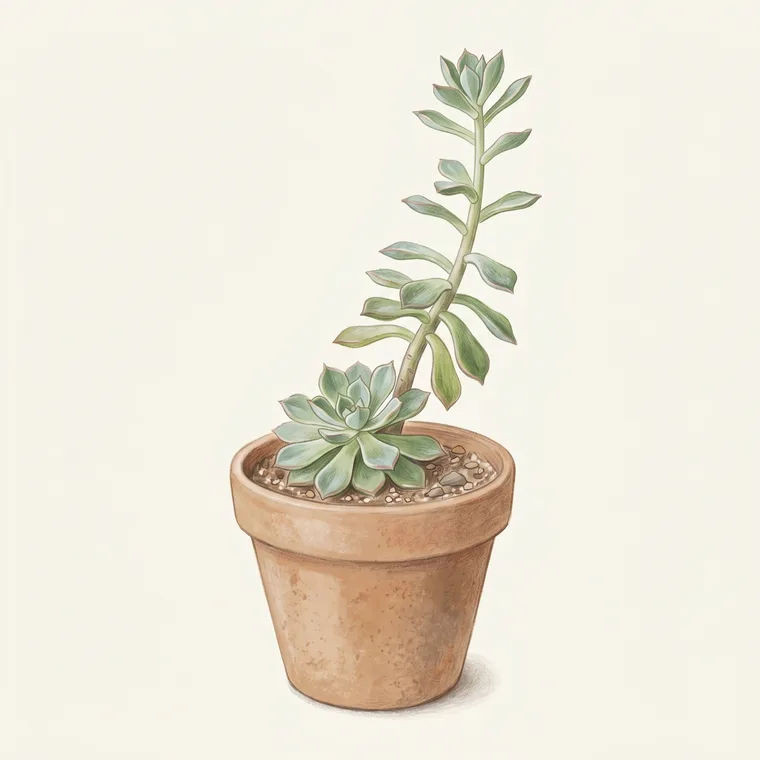
An echeveria stretches because it is starved of light. Deprived of the bright sun it evolved for, the rosette pales, the leaves space out and point upward, and the centre lifts on a lengthening bare stem — a process called etiolation. More light is the only real fix. The stretched section will never tighten back up, but you can behead and re-root the rosette to start a compact plant again.

Causes, most likely first
- 1. Too little light (etiolation)
How to tell: The once-tight rosette opens up, the leaves grow further apart and tilt upward toward the window, the colour fades to pale green, and a bare stem appears beneath the rosette.
Fix: Move it to the brightest spot you have — a south-facing sill or, once acclimatised, outdoors in summer. Several hours of direct sun keep the rosette tight and richly coloured.
- 2. Short winter days indoors
How to tell: Stretching sets in over winter even on a windowsill, as the low, weak sun and short days no longer supply enough light to keep growth compact.
Fix: Give it the sunniest winter position you can, or add a grow light for a few hours a day; reduce watering in the dim months so weak, soft growth is not encouraged.
- 3. Overwatering driving soft, lush growth
How to tell: Frequent watering combined with low light produces fast, soft, pale, elongated growth rather than the firm, compact rosette of a sun-grown plant.
Fix: Water only when the soil has dried out fully and pair that with much brighter light. Lean, bright conditions keep an echeveria stocky; rich, shaded conditions make it stretch.
Preventing a recurrence
Echeverias come from the bright, semi-arid highlands of Mexico and Central America, where strong sun keeps their rosettes packed tight and colourful, so the way to prevent stretching is simply to give them as much direct light as you can. A sunny windowsill, or a summer outdoors after gradual acclimatisation, keeps the leaves short, firm and close together. Watering sparingly in gritty, fast-draining mix reinforces compact growth.
If a rosette has already stretched, you cannot shrink the gappy section back, but you can cut the rosette off with a short stem, let it callus for a few days, and re-root it into a tidy new plant — and the bare stump often sprouts offsets too. Keep the new plant in full sun from the start to stop it stretching again.
Frequently asked questions
Can a stretched echeveria go back to a tight rosette?
No — once the leaves have spread out and the stem has lengthened, that section stays stretched permanently, because the gaps cannot close. What you can do is behead the rosette and re-root it into a fresh, compact plant, and keep it in full sun so the new growth stays tight from the start.
How do I fix a leggy echeveria?
Cut the rosette off cleanly, leaving a couple of centimetres of stem, let the cut callus over for a few days, then set it on or just into dry gritty mix to root. The bare stem you leave behind often pushes out new offsets. Give both the brightest light you have so they grow compact rather than stretching again.
How much light does an echeveria need to stay compact?
Plenty — ideally several hours of direct sun a day. A bright south or west window indoors, or a sheltered sunny spot outdoors in summer once it is hardened off, keeps the rosette tight and brings out the colours. Anything less and it gradually stretches toward whatever light it can find.
Is a stretched echeveria unhealthy or just less pretty?
Stretching is mostly a cosmetic and structural issue rather than a disease — the plant is alive and growing, just reaching for light. Over time, though, the soft elongated growth is weaker and a long bare stem can flop, so it is worth correcting the light and, if needed, re-rooting the rosette for a sturdier, better-looking plant.
Sources
- RHS — Echeveria care — Royal Horticultural Society, checked 2026-06-15
- Missouri Botanical Garden — Echeveria — Missouri Botanical Garden, checked 2026-06-15