Why are my orchid leaves turning yellow?
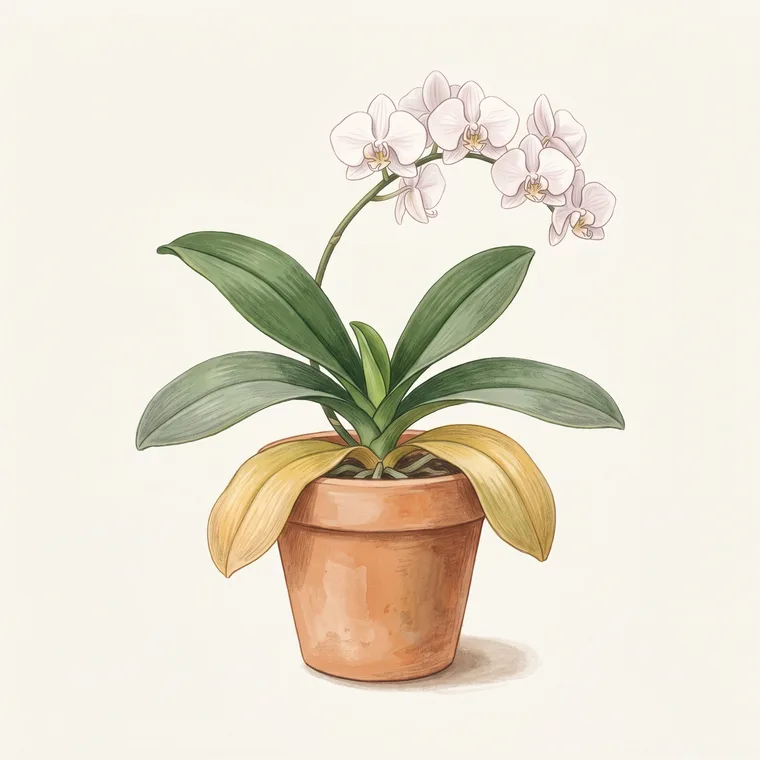
A yellowing moth orchid leaf is usually one of two things: overwatering that has rotted the roots so they can no longer feed the leaf, or natural ageing of the oldest lower leaf. Sunburn is the third. Slide the plant from its clear pot and look at the roots — plump and green or silver is healthy, brown and mushy is rot. That, plus where on the plant the yellowing sits, tells you which it is.

Causes, most likely first
- 1. Overwatering and root rot
How to tell: Several leaves yellow and go soft, the roots in the clear pot look brown, mushy or hollow rather than firm and green, and the bark mix has stayed wet.
Fix: Unpot, cut away every soft brown root with sterile scissors, and repot into fresh dry orchid bark. Water only when the roots silver and the bark is nearly dry, never on a fixed schedule.
- 2. Natural ageing of the oldest leaf
How to tell: A single lowest leaf yellows slowly and evenly while the rest of the plant, and especially the newest leaf, looks firm and green.
Fix: Leave it to yellow fully and detach naturally, or trim it off cleanly. The orchid is simply shedding an old leaf, and this is nothing to correct.
- 3. Too much direct sun
How to tell: Leaves on the side facing a bright window yellow or bleach, sometimes with a sunken brown burnt patch in the middle of the leaf.
Fix: Move it to bright indirect light — an east window or behind a sheer curtain. Phalaenopsis leaves should be a healthy grass-green, never bleached yellow by direct sun.
- 4. Cold shock or a chilly draught
How to tell: Yellowing follows a cold spell, a draughty windowsill in winter, or a cold delivery; the leaves may also show watery patches.
Fix: Keep the orchid in a stable warm spot above 16 °C, away from cold glass and draughts, and remove badly damaged leaves once it has recovered.
Preventing a recurrence
Phalaenopsis orchids grow as epiphytes clinging to tree bark in humid Southeast Asian forests, their roots wrapped in fast-draining debris and dappled by filtered light, never sitting in soggy ground or blasted by sun. Yellow leaves are usually the gap between that and a windowsill. Pot in chunky bark, water only when the roots silver and the mix dries, and give bright indirect light, and the leaves stay green.
Grow it in a clear pot so you can watch the roots — they are the early warning system, turning brown and soft before the leaves yellow if the plant is too wet. Steady warmth, good airflow, and watering by root colour rather than the calendar prevent nearly all the avoidable yellowing.
Frequently asked questions
Should I cut off a yellow orchid leaf?
If it is an old lower leaf yellowing naturally, you can let it detach on its own or trim it once it is mostly yellow. If the leaf is yellowing because the roots have rotted, the priority is fixing the roots; remove the leaf only after, with sterile scissors, to avoid spreading any infection.
How do I check my orchid's roots for rot?
Slide the plant out of its clear plastic pot, or look through the side. Healthy roots are firm and plump, green when wet and silvery when dry. Rotted roots are brown or black, soft, mushy, or hollow and stringy when squeezed. The state of the roots is the most reliable guide to why a leaf is yellowing.
Why is the bottom leaf of my orchid yellow but the rest is fine?
A single lowest leaf turning yellow while the newer leaves stay green and firm is almost always normal ageing — orchids shed their oldest leaf periodically as they grow new ones from the top. As long as the roots look healthy, there is nothing to fix; just let the old leaf finish and drop.
Can too much sun turn orchid leaves yellow?
Yes. Direct sun, especially through glass in summer, bleaches Phalaenopsis leaves to a washed-out yellow and can leave a sunken burnt patch. The leaves should be a fresh grass-green; a yellow-green, washed look means too much light. Move it to bright indirect light to prevent further scorching.
Sources
- American Orchid Society — Phalaenopsis culture — American Orchid Society, checked 2026-06-15
- Missouri Botanical Garden — Phalaenopsis (moth orchid) — Missouri Botanical Garden, checked 2026-06-15