Why are my peace lily leaves turning yellow?
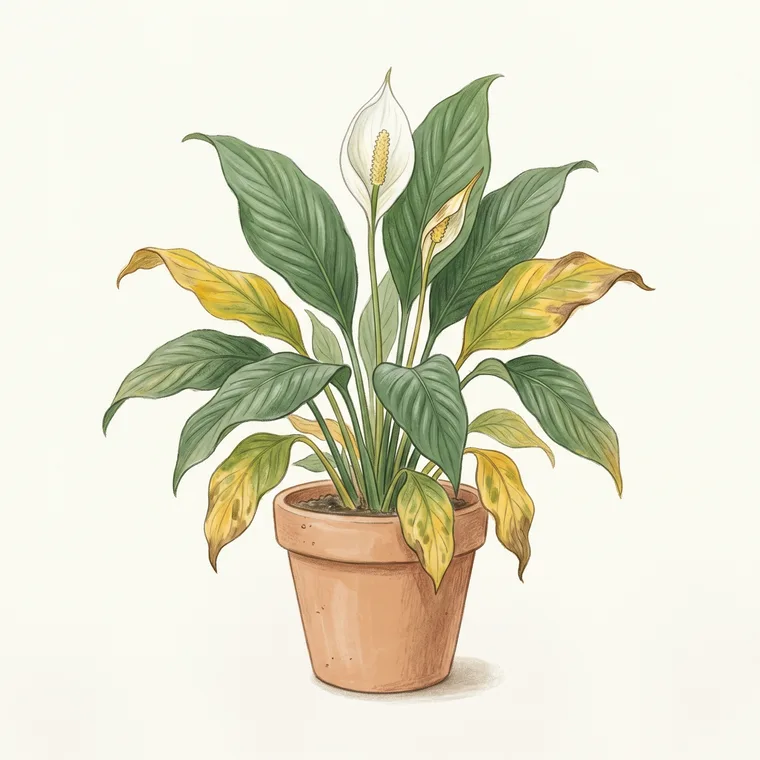
Yellowing peace lily leaves usually trace back to watering gone wrong in one direction or the other: roots left soggy too long, or a plant repeatedly allowed to wilt bone dry. A single old lower leaf yellowing slowly is just natural ageing. Direct sun is the other common culprit, bleaching leaves pale yellow. Check the soil and the light before you change anything else.

Causes, most likely first
- 1. Overwatering or poor drainage
How to tell: Several leaves yellow at once, often lower down, the soil stays wet for days, and the stems near the base feel soft — classic signs the roots are drowning.
Fix: Let the top few centimetres dry before the next water, empty the saucer, and check the roots for brown mushy rot, trimming any you find before repotting in fresh mix.
- 2. Repeated drought and wilting
How to tell: The plant has dramatically collapsed and been revived several times; after each bone-dry spell a few leaves yellow and never green up again.
Fix: Water more consistently, before it wilts, keeping the soil lightly and evenly moist. A peace lily forgives the odd dry spell but yellows leaves if you make a habit of it.
- 3. Too much direct sunlight
How to tell: Leaves nearest a bright window turn pale and yellow, sometimes with scorched brown patches, while shaded leaves stay deep green.
Fix: Move it out of direct sun into bright indirect or even moderate shade — a peace lily is one of the better low-light houseplants and dislikes harsh light.
- 4. Natural ageing of an old leaf
How to tell: A single oldest leaf at the bottom yellows gradually while all the newer growth above it stays healthy and green.
Fix: Nothing to fix — let it finish yellowing and remove it at the base. The plant is recycling nutrients from a leaf it no longer needs.
Preventing a recurrence
A peace lily grows on the shaded, humid floor of tropical American rainforests, in soil that stays evenly moist but never waterlogged and under a canopy that filters out direct sun. Yellow leaves are usually the gap between those conditions and a living room. Keep the soil lightly moist — watered before it dries fully, drained so it is never soggy — and the plant green and steady.
Sit it in bright indirect light out of any direct beam, feed lightly through spring and summer, and avoid the dramatic dry-then-flood cycle that the peace lily's famous wilting tempts you into. Steady moisture and steady light prevent most of the yellowing.
Frequently asked questions
Should I remove yellow leaves from my peace lily?
Once a leaf has gone fully yellow it will not turn green again, so cut it off at the base with clean scissors to keep the plant tidy and channel energy into new growth. A leaf that is only part yellow can stay a while if the plant is short on foliage.
Why does my peace lily have yellow leaves and brown tips together?
That combination usually points to inconsistent watering plus tap-water minerals or dry air. The yellowing comes from the moisture swings while the brown tips come from salts and low humidity. Even out the watering, flush the pot occasionally, and raise humidity a little.
Can too little light make a peace lily's leaves yellow?
Deep shade more often makes a peace lily simply stop flowering and grow leggy than turn yellow. Yellowing is far more likely from watering problems or, conversely, too much direct sun. If it is in a very dark corner, move it somewhere brighter but still out of direct beams.
Is it normal for a new peace lily to yellow a few leaves after I bring it home?
A little yellowing after a move is common adjustment stress as the plant adapts to new light, humidity and watering. Settle it into a stable spot in bright indirect light, water consistently, and the new growth that follows should come through green.
Sources
- RHS — Spathiphyllum (peace lily) care — Royal Horticultural Society, checked 2026-06-15
- Missouri Botanical Garden — Spathiphyllum (peace lily) — Missouri Botanical Garden, checked 2026-06-15