Why won't my orchid rebloom?
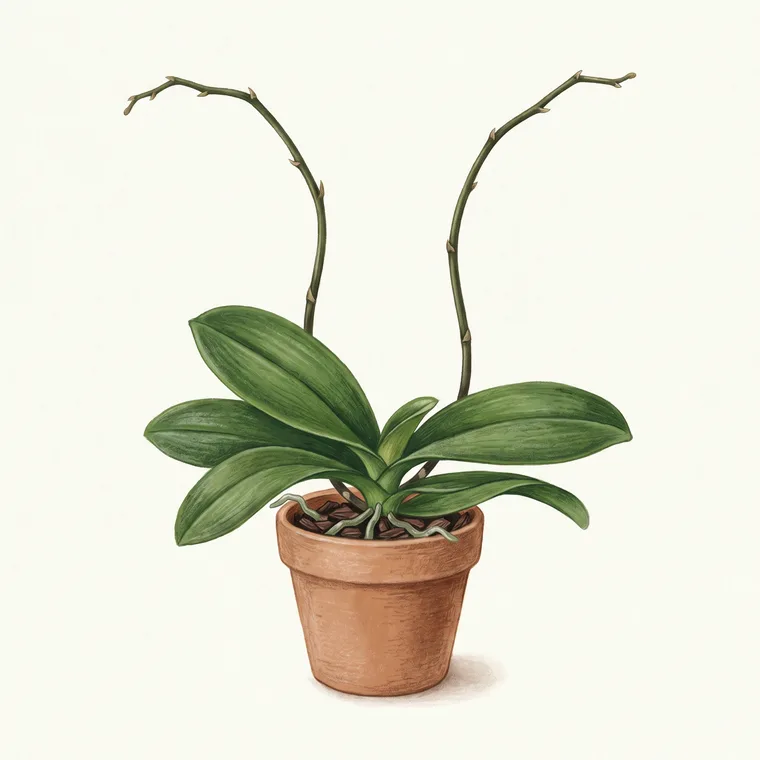
A missing nighttime chill is the most common reason a moth orchid refuses to rebloom. Phalaenopsis sets a new flower spike when night temperatures fall to roughly 13–16 °C (55–60 °F) for several weeks, a cue most centrally heated homes never deliver. Give it cooler nights, plus brighter light, and a spike usually follows. Too little light and year-round feeding are the next suspects.

Causes, most likely first
- 1. No nighttime temperature drop
How to tell: A healthy, leafy orchid kept at a steady 20–22 °C day and night for months simply never produces a new spike.
Fix: Give it four to six weeks of cooler nights around 13–16 °C (55–60 °F) — a windowsill in autumn, or a cool room — while keeping days warmer. The 5–10 °C day-to-night swing is what triggers spiking.
- 2. Too little light
How to tell: Leaves are dark, floppy green rather than a healthy mid-green, and the plant grows leaves but no flower spikes.
Fix: Move it to bright indirect light — an east window is ideal. Leaves should be a lively grass-green; too dark means too little light to fund flowering.
- 3. Continued high feeding during the rest period
How to tell: The plant is fed regularly all year, pushing leaves and roots but never switching into flowering mode.
Fix: Ease off nitrogen after flowering and use a balanced or bloom-type feed at quarter to half strength; let the plant rest cooler and slightly leaner to encourage a spike.
- 4. The plant is too young or still recovering
How to tell: A small orchid with fewer than five or six mature leaves, or one that recently bloomed heavily, is not yet ready to flower again.
Fix: Keep it healthy and patient — a spike can take a couple of months to emerge and three months more to open. Maturity and a good root system come first.
Preventing a recurrence
Phalaenopsis orchids grow as epiphytes clinging to trees in the humid forests of Southeast Asia, where a seasonal dip in night temperature signals the right time to flower. Recreate that cue and reblooming stops being mysterious: a stretch of cooler nights in autumn, steady bright indirect light, and a slightly leaner, drier rest is the recipe that brings the spike.
Day to day, water by weight and root colour rather than a schedule — the silvery roots turn green when hydrated — and never let the plant sit in water, which rots the roots and ends any chance of flowers. A mature, well-rooted orchid in good light, given its cool nights, reliably spikes once a year.
Frequently asked questions
How cold do the nights need to be to make my orchid rebloom?
Aim for night temperatures around 13–16 °C (55–60 °F) for four to six weeks, while days stay warmer. It is the difference between day and night — a swing of roughly 5–10 °C — that signals a Phalaenopsis to push out a new spike.
Should I cut the old flower spike to get my orchid to rebloom?
It depends on the spike's colour. A still-green spike can be trimmed back to a node lower down, where it sometimes throws a side branch that flowers again. A spike that has gone brown and woody is spent — remove it at the base so the plant channels its energy into a brand-new one.
How long after the cool nights will my orchid flower?
Be patient: a new spike typically emerges a few weeks to a couple of months after the cool spell, then takes roughly three more months to grow and open its first flowers. Steady light and care throughout that stretch matter as much as the trigger.
My orchid grows new leaves and roots but no flowers — why?
Healthy leaves and roots but no spike usually means the flowering cue is missing rather than the plant being unwell. Most often it has had no nighttime temperature drop; sometimes the light is too low or it is still building maturity. Supply the cool nights and good light.
Sources
- American Orchid Society — Why won't my orchid rebloom? — American Orchid Society, checked 2026-06-13
- Missouri Botanical Garden — Phalaenopsis (moth orchid) — Missouri Botanical Garden, checked 2026-06-13