Why is my rubber plant dropping its leaves?
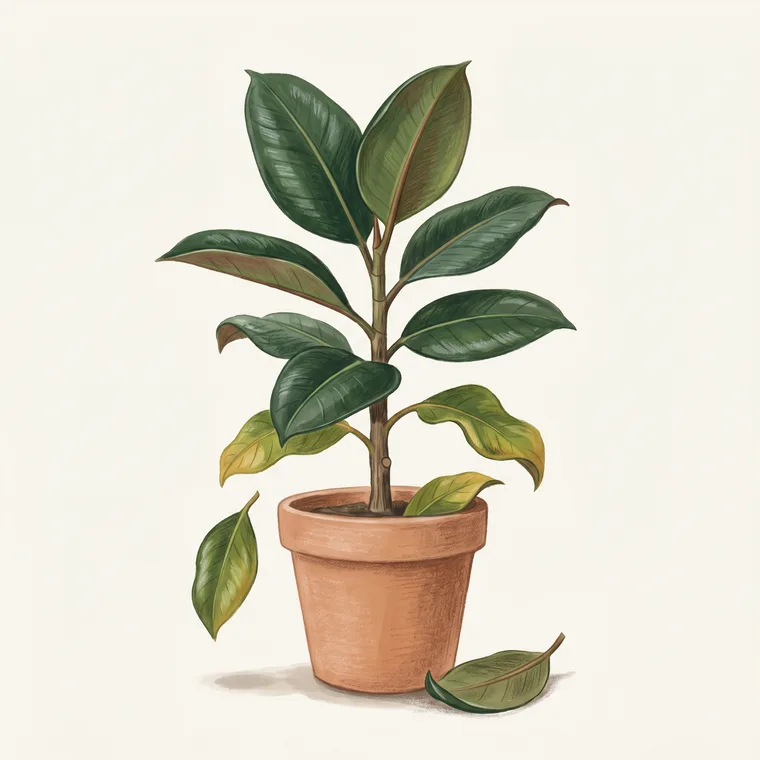
Like its fig relatives, a rubber plant responds to stress by dropping leaves, and the trigger is usually a recent change — a move to a new spot, a cold draught, or a watering routine that lurched. Overwatering is the other big cause, rotting roots so the lowest leaves yellow and fall. Work out what shifted, then steady the plant in one warm, bright, draught-free place and keep its watering even.

Causes, most likely first
- 1. Overwatering and soggy roots
How to tell: Lower leaves yellow and drop while the soil stays wet for days; the plant feels heavy in its pot and the stem base may be soft — the roots are waterlogged.
Fix: Let the top few centimetres dry before watering again, make sure the pot drains and the saucer is emptied, and check the roots for brown mushy rot, trimming any you find.
- 2. Cold, draughts, or a sudden move
How to tell: Leaf drop follows a relocation, a chilly spell below about 12 °C, or a spot near a draughty door or vent; the dropped leaves are often otherwise healthy-looking.
Fix: Settle it in a warm, stable position out of draughts and away from cold glass, ideally 16–24 °C, and avoid moving it again while it readjusts.
- 3. Too little light
How to tell: In a dim corner the plant slowly drops its lower leaves and grows leggy with bare lengths of stem, unable to support the older foliage.
Fix: Move it to bright indirect light near a window. A rubber plant keeps its lower leaves far better in good light than in shade.
- 4. Letting the soil go bone dry
How to tell: After a long dry spell the leaves brown at the edges, curl, and then drop; the soil has pulled away from the sides of the pot.
Fix: Water thoroughly and settle into checking the soil regularly so it never fully dries out; the plant likes lightly moist, not soggy and not parched.
Preventing a recurrence
Ficus elastica grows into a large tree in the warm, humid forests from northeast India through Indonesia, and like the fiddle-leaf fig it treats abrupt change as a reason to shed leaves. So the steady-conditions rule applies here too: a fixed bright spot, even warmth, no draughts, and watering when the top few centimetres dry rather than on a swinging schedule. A rubber plant whose environment holds steady keeps its leaves.
Wipe the broad leaves occasionally so they gather light efficiently, feed lightly in the growing season, and let the plant adjust undisturbed after any move. Avoid the two extremes — soggy roots and bone-dry soil — and the dramatic leaf drop largely disappears.
Frequently asked questions
Will a rubber plant regrow leaves where it dropped them?
It rarely re-leafs a bare lower section on its own; new growth comes mainly from the top. To fill out a leggy stem you can prune the growing tip once the plant is healthy, which prompts it to branch and push out new shoots lower down. Be ready for it to ooze milky sap when cut.
Why is my rubber plant dropping leaves in winter?
Winter brings the rubber plant's two main triggers together: weaker light and cold draughts from windows and heating cycles, while a summer watering routine becomes overwatering as growth slows. Move it to the brightest spot, keep it away from cold glass and vents, and water less often until spring.
Is the milky sap from a dropped rubber plant leaf dangerous?
The white latex can irritate skin and is mildly toxic if eaten, and the plant is listed as toxic to cats and dogs by the ASPCA, so wash it off your hands and keep pets from chewing fallen leaves. It is an irritant rather than a severe poison, but treat it with sensible caution.
How much leaf drop is normal for a rubber plant?
Losing the occasional old lower leaf over time is normal as the plant grows taller. Sudden loss of several leaves at once, or steady shedding week after week, is the kind that signals a problem — usually a recent change, a draught, or overwatering — and is worth tracking down.
Sources
- RHS — Ficus elastica (rubber plant) — Royal Horticultural Society, checked 2026-06-15
- Missouri Botanical Garden — Ficus elastica (rubber plant) — Missouri Botanical Garden, checked 2026-06-15