Why does my fiddle-leaf fig have brown spots?
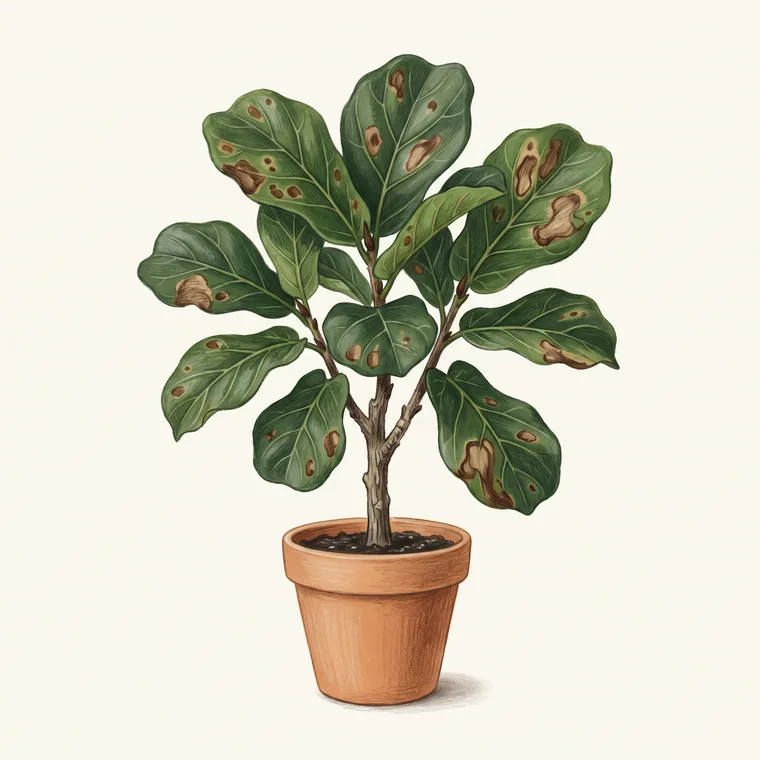
Read the location before you change anything: dark brown spots that start in the centre or base of the leaf and spread outward signal overwatering and root rot, the classic fiddle-leaf killer. Dry, crispy brown that begins at the edges and tips points instead to underwatering, low humidity, or sun scorch. Pull the plant up and check the roots if the spots are dark and soft.

Causes, most likely first
- 1. Overwatering and root rot
How to tell: Dark brown or black spots appear in the middle and base of leaves and spread outward; lower leaves go first, the soil stays wet, and the roots smell sour and feel mushy.
Fix: Unpot it, cut away brown mushy roots back to firm tan tissue, and repot in fresh, free-draining mix. Then water only when the top 3–5 cm has dried, and never leave it sitting in a full saucer.
- 2. Underwatering and dry air
How to tell: Brown patches are dry and crispy, start at the edges and tips, and the soil has pulled away from the pot; leaves all over the plant are affected.
Fix: Water thoroughly until it drains, settle into a regular cadence so the soil never bone-dries, and raise humidity away from radiators and vents.
- 3. Sunburn from direct light
How to tell: Tan or bleached brown patches appear only on the leaves or the side facing a bright, sunny window, often after a move.
Fix: Pull it back from the glass into bright indirect light. Introduce any increase in sun gradually so the leaves can adjust.
- 4. Cold draughts or a sudden temperature swing
How to tell: Brown spots and leaf drop follow a move, an open window in winter, or a spot near an air-conditioning vent or exterior door.
Fix: Relocate it to a stable, draught-free spot above 15 °C (60 °F); fiddle-leaf figs hate sudden change and react with blemishes and dropped leaves.
Preventing a recurrence
Ficus lyrata grows into a tall tree in the warm, humid lowland rainforests of western Africa, where conditions stay steady year-round. That steadiness is the whole secret to a spotless fiddle-leaf fig: pick one bright, draught-free spot and leave it there, because this plant punishes being moved, chilled, or swung between drought and flood with exactly the brown spots people panic over.
Water on a rhythm rather than a schedule — a thorough soak when the top few centimetres dry, then let it drain completely. Bright indirect light, average-to-high humidity, and the occasional dusting of those big leaves keep new growth clean and green.
Frequently asked questions
How can I tell overwatering brown spots from underwatering ones?
Watch where they start and how they feel. Overwatering makes dark spots that begin in the centre or base of the leaf and feel as soft as the rest of the leaf; underwatering makes dry, crispy brown that starts at the edges and tips. Checking the roots and the soil moisture settles it.
Will the brown spots on my fiddle-leaf fig leaves go away?
No — damaged leaf tissue cannot heal or turn green again. The goal is to stop new spots forming by fixing the cause; the marked leaves can stay for photosynthesis or be removed once new clean growth appears.
Should I cut off leaves with brown spots?
Remove a leaf that is more than half brown or clearly dead, but keep lightly spotted leaves if the plant is sparse — it still needs them to feed itself. Take off no more than a few at a time so you do not stress an already struggling tree.
Why did my fiddle-leaf fig get brown spots after moving it?
Fiddle-leaf figs are unusually sensitive to change. A new spot can mean different light, a draught, or a temperature shift, any of which shows up as brown blotches and dropped leaves a week or two later. Give it time to acclimatise in one stable position.
Sources
- RHS — Ficus lyrata (fiddle-leaf fig) care — Royal Horticultural Society, checked 2026-06-13
- Missouri Botanical Garden — Ficus lyrata — Missouri Botanical Garden, checked 2026-06-13